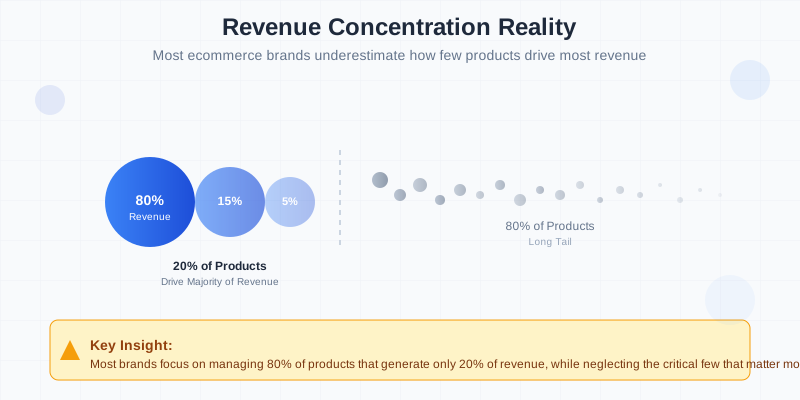
Why Most Ecommerce Brands Underestimate Revenue Concentration
Most ecommerce brands know their total revenue.
Very few understand how fragile it actually is.
Revenue concentration — the percentage of revenue generated by a small group of customers — is one of the most overlooked growth metrics in ecommerce.
And underestimating it can quietly limit your growth.
Let’s break down why this happens.
📊 What Is Revenue Concentration?
Revenue concentration measures how much of your total revenue comes from a small percentage of customers.
In many ecommerce stores:
- 20% of customers generate 70–80% of revenue
- A small high-value segment drives most repeat purchases
- Losing a handful of customers would significantly impact revenue
This is often called the Pareto Principle (80/20 rule).
But most brands never actually calculate it.
They assume their revenue is more evenly distributed than it really is.
🚨 Why Brands Underestimate Revenue Concentration
1️⃣ They Focus on Averages
Brands track:
- Average order value
- Overall conversion rate
- Blended ROAS
Averages hide extremes.
If a small group spends 10x more than the rest, averages won’t reveal that imbalance.
2️⃣ Dashboards Don’t Show Distribution
Most ecommerce dashboards show:
✅ Total revenue
✅ Orders
✅ Traffic
✅ Conversion rate
They don’t show:
❌ Revenue by customer percentile
❌ Cumulative revenue contribution
❌ High-value customer tiers
Without distribution analysis, concentration stays invisible.
3️⃣ Acquisition Gets More Attention Than Retention
Paid ads are visible.
Retention is quiet.
When brands focus heavily on acquiring new customers, they overlook:
- Which customers drive long-term value
- Whether growth is dependent on a small loyal segment
- How vulnerable revenue really is
Concentration is a retention insight — not an acquisition metric.
4️⃣ Manual Analysis Is Friction Heavy
To properly calculate revenue concentration manually, you need to:
- Aggregate revenue per customer
- Sort customers by revenue
- Calculate cumulative percentage
- Identify revenue thresholds
Most teams never go through that process.
So they guess.
⚠️ Why Underestimating It Is Risky
If revenue is highly concentrated and you don’t know it:
- Losing a few high-value customers can sharply reduce revenue
- Your retention strategy may be underdeveloped
- Your acquisition strategy may attract low-LTV buyers
- Your business becomes more fragile than it appears
Revenue size ≠ revenue stability.
Structure matters.
📈 What Happens When You Actually Measure It
When brands calculate revenue concentration, they often discover:
- 10–15% of customers drive the majority of profit
- Repeat buyers have dramatically higher LTV
- Certain products attract high-value segments
- Some acquisition channels produce low-quality buyers
This changes decision-making completely.
You stop asking:
“How do we increase traffic?”
And start asking:
“How do we acquire more customers like our top 10%?”
That’s a growth shift.
🎯 How to Calculate Revenue Concentration
At a high level:
- Calculate total revenue per customer
- Sort customers from highest to lowest
- Compute cumulative revenue percentage
- Identify what % of customers drive 50%, 70%, 80% of revenue
Once you see the curve, it’s hard to ignore.
🧠 The Real Insight
Most ecommerce brands underestimate revenue concentration because:
- They rely on surface metrics
- They look at totals, not distribution
- Their dashboards don’t visualize customer tiers
- Manual analysis feels complex
But growth becomes easier when you understand who truly drives your revenue.
Clarity reduces randomness.
🚀 Turn Revenue Into Structure
Smart Query helps ecommerce teams instantly uncover:
✅ What % of revenue comes from the top 20%
✅ Who your highest-value customers are
✅ How revenue is distributed across segments
✅ Where retention drives growth
No SQL.
No complex spreadsheets.
Just growth clarity.
Final Thought
If you’ve never calculated your revenue concentration, there’s a good chance you’re underestimating it.
And what you underestimate, you can’t optimize.